Complex numbers work because they are closed. Multiply two of them and you get a third; the operation never takes you outside the system. That closure is what makes them useful for rotations in a plane, and it is why they turn up everywhere in two-dimensional problems.
The obvious next question is whether the same trick works in three dimensions. William Rowan Hamilton spent something like thirteen years on it. The answer, which cost him those years, is that it does not — and that the case which does work is four-dimensional.
What follows is what he found, and why the structure is stranger than it first appears.
The multiplication rule
A quaternion has four real components and three distinct imaginary units:
The units obey a single compact rule, the one Hamilton carved into Broom Bridge in Dublin on 16 October 1843:
Everything else follows from it. Each unit squares to −1, as the ordinary imaginary unit does. But taken in pairs they behave in a way that has no counterpart in the complex numbers:
Read the second line carefully. The order matters. Multiplying i by j does not give the same answer as multiplying j by i — it gives the opposite sign.
This is the property that makes quaternions worth the trouble, and also the reason they are unfamiliar. Ordinary numbers commute. Complex numbers commute. Quaternions do not, and any intuition built on the assumption that xy equals yx fails here immediately.
Splitting the object in two
It is convenient to separate a quaternion into two parts of different character: a single real number, and the three components carrying the imaginary units.
Written this way, Q can be identified with an ordinary vector in three-dimensional space, with components b, c, d. So a quaternion is a scalar and a vector, carried together in one object rather than treated as two separate things.
Addition is unremarkable: the scalars add, the vectors add, and multiplication by an ordinary real number scales both. It is multiplication where something happens.
The product, worked out
Take two quaternions with no scalar part at all — two pure vectors, P and Q — and multiply them using nothing but the rule above.
The expansion has nine terms. Three of them pair a unit with itself, and each contributes a factor of −1: these produce −P₁Q₁, −P₂Q₂, −P₃Q₃. Together they are minus the dot product, and being products of real numbers they carry no imaginary unit — they are a pure scalar.
The remaining six pair different units, and this is where the anticommutation earns its keep. The pair ij gives k, the pair ji gives −k; collecting them leaves a difference of products rather than a sum. That difference is exactly the cross product.
The result:
One multiplication. Two familiar operations, both produced at once, from an algebra in which neither was put in by hand. The dot product falls out of the squares of the units; the cross product falls out of their refusal to commute.
For quaternions with scalar parts as well, the general product is
and the non-commutativity is now visible in one place: every term is symmetric under exchange of the two factors except the cross product, which changes sign. Two quaternions commute only when their vector parts are parallel.
Why four dimensions and not three
What Hamilton wanted was not merely a system where multiplication is defined, but one where it can be undone: an algebra in which every non-zero element has an inverse, so that division always works. That is a strong requirement, and it is the reason three dimensions fail.
Define the conjugate by flipping the sign of the vector part alone:
and multiply a quaternion by its own conjugate. In the general product above, the cross-product term becomes Q × (−Q), which vanishes identically — any vector’s cross product with itself is zero. The scalar-vector terms cancel against each other. What survives is purely scalar:
a sum of four squares, and therefore zero only when every component is zero. This gives the norm, and with it the inverse:
Every non-zero quaternion can be divided by. Along with the real numbers and the complex numbers, this makes quaternions one of a very short list — and Frobenius later proved the list is complete for associative algebras over the reals. There is no five-dimensional version, no seven. The four-dimensional case is not one option among many; it is the last one available.
The mechanism behind that calculation is worth keeping in view, because it recurs: anything times its own conjugate collapses to a pure scalar, because a vector’s cross product with itself always vanishes. It is a small fact, and a good deal rests on it.
A picture, and what it hides
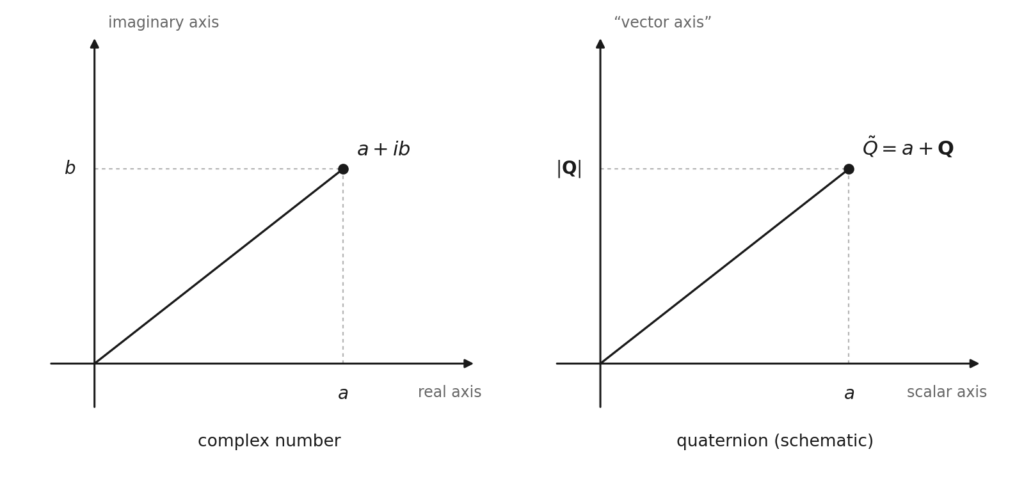
The figure is a mnemonic, not a diagram of the structure. A complex number splits into a real and an imaginary coordinate; a quaternion splits into a scalar and a vector part, and plotting the magnitude of that vector part on a single axis reproduces the right relationship for the norm, since
depends on Q only through its magnitude, exactly as the modulus of a complex number depends only on b.
Two things are hidden rather than simplified, and both matter.
The direction of Q is gone. Compressing three components onto one axis keeps the magnitude and discards everything else, and no amount of redrawing fixes this: adding a third axis would recover two of the three components and arbitrarily privilege them over the third. What is needed is not another axis but a change of kind — the vector part promoted to a genuine three-dimensional subspace, with the scalar carried as a fourth coordinate alongside it. That is a four-dimensional object, and it cannot be drawn.
And the non-commutativity is invisible. Nothing a two-dimensional picture can suggest reproduces the actual product, because the picture has no way to express that the order of multiplication changes the answer. The figure is authoritative on the norm, and on nothing else.
What the algebra is good for
The immediate application, and the one still in daily use, is rotation. Unit quaternions represent rotations in three-dimensional space without the degenerate configurations that afflict angle-based descriptions, and they compose by multiplication. Computer graphics, robotics and spacecraft attitude control all run on this.
But the property that matters for physics is the one that came out of the product above. In the vector calculus that replaced quaternions in the 1880s, the dot product and the cross product are two separate operations, defined independently, with no structural relation to each other. In quaternion algebra they are two parts of a single multiplication — and any product of two quaternions carrying vector parts necessarily generates both.
That is a statement about algebra, not about physics, and nothing here claims otherwise. But it is worth noticing that a formalism which cannot produce one without the other will behave differently, when applied to a physical problem, from one in which the two are separate by construction.
Sources
- W. R. Hamilton, “On quaternions,” Proc. R. Irish Acad., vol. 3, pp. 1–16, 1847.
- G. Frobenius, “Über lineare Substitutionen und bilineare Formen,” J. Reine Angew. Math., vol. 84, pp. 1–63, 1878.
- A. Gsponer and J.-P. Hurni, “The Physical Heritage of Sir W. R. Hamilton,” arXiv:math-ph/0201058.
Leave a Reply