Charge a capacitor to V. Disconnect it. Now connect it, through a switch, to a second identical capacitor that is empty. Close the switch.
Charge is conserved, and by symmetry it ends up shared equally, so both capacitors settle at half the original voltage. That much is uncontroversial and takes one line.
Now count the energy. Before: one capacitor at V, holding half CV2. After: two capacitors, each at V/2, each holding a quarter of half CV2, for a total of one quarter CV2. Exactly half the energy has gone missing.
The usual reaction is that this is a schoolroom trick and the answer is friction — some resistance somewhere ate it. That reaction is correct and also completely inadequate, because the interesting thing about this problem is not that energy is lost. It is how much, and what that quantity does not depend on.
The resistor is not the culprit
Put a resistor R in the connecting loop and do the integral.
The two capacitors in series present C/2, so the loop time constant is RC/2. The current starts at V/R and decays exponentially. The energy delivered to the resistor is the integral of i2R, which comes to
and R has cancelled. It is not there. Double the resistance and the current halves while the transient lasts twice as long; the square of the current falls by four and the duration rises by two, and the product is fixed.
So the missing quarter of CV2 is not a property of the connecting wire. It is fixed entirely by where the charge started and where it ended. The resistor is not the cause of the loss; it is merely the place where the loss happens to be deposited, and it will accept exactly the amount required of it whatever its value.
This is worth restating because it inverts the usual intuition. One expects a lossy component to determine how much is lost. Here the loss is determined first, by the endpoints alone, and the component only reveals where it went.
The general case
Nothing about this depends on the capacitors being equal. Take two capacitors of any values at any voltages and connect them. Charge conservation fixes the common final voltage as the charge-weighted average, and the energy that disappears is
The prefactor is the series combination of the two capacitances, and the loss goes as the square of the initial voltage difference. It vanishes only when the two are already at the same voltage — that is, when nothing happens. Any transfer of charge between two capacitors at different potentials costs energy, and the cost is set before the transfer begins.
Taking the resistance away
If R never appears in the answer, what happens when we set it to zero?
The formula still says a quarter of CV2 is lost, and now there is nothing to lose it to. This is the point at which the problem stops being a trick and becomes a real question.
The first thing to notice is that a loop of wire with no resistance still has inductance, and inductance changes the story completely. With L in the circuit the charge does not simply flow across and stop. It overshoots. The system is a series LC resonator and the charge sloshes back and forth between the two capacitors, the first one emptying past the halfway point, refilling, emptying again.
With any resistance at all, however small, the oscillation is damped and the system does eventually settle at the shared voltage — and the total dissipated over the whole ringing transient is again exactly a quarter of CV2. Not approximately: exactly, and independently of both R and L. The route changes completely; the destination does not.
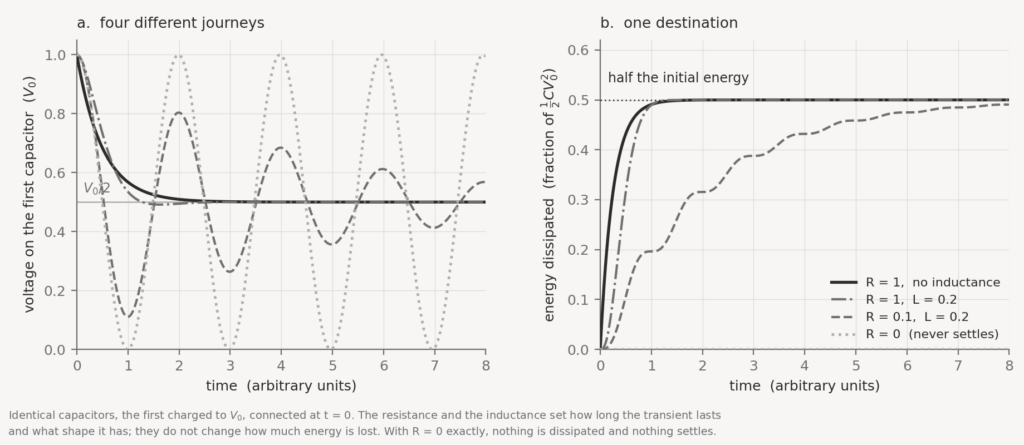
With R exactly zero and L greater than zero, something else happens: the oscillation never decays. There is no final state. The first capacitor returns periodically to its full initial voltage, and the energy is never lost because the system never arrives anywhere.
This is the cleanest resolution of the paradox as usually posed, and it deserves to be stated plainly. The premise smuggles in the answer. Saying that the capacitors “end up” at V/2 is already an assumption that the transient dies, and a transient can only die by depositing its energy somewhere. Ask where half the energy went, having assumed a final state, and you have assumed the dissipation you are then surprised to find.
And with no inductance either
One can press further. Suppose the loop had neither resistance nor inductance — no ringing and no heating. Then where?
At this point the lumped-circuit description has been asked for more than it can give. A loop with genuinely zero inductance would have to enclose no area, and a loop enclosing no area is not a circuit. Any real arrangement of two capacitors and a switch occupies space, and while the charge is redistributing it is accelerating, and accelerating charge radiates.
The radiated fraction is negligible in any ordinary bench experiment, which is why nobody notices it and why the textbook answer of “the resistance” is a perfectly good practical answer. But it is not zero, and it cannot be made zero by improving the components, because it is a consequence of the geometry rather than of the materials. Radiation resistance is a property of shape. The idealisation that removes both R and L is the one that has left physics, not the one that has found a paradox in it.
What the problem is actually about
The structure here is worth separating from the specific circuit, because it recurs.
There is a class of results in which a quantity is fixed by the initial and final states alone, while the mechanism that produces it is left entirely free. The energy lost in redistributing charge between capacitors is one. It does not care whether the loss occurs in a resistor, in the damping of an oscillation, or in radiated fields; it does not care how long any of that takes. The bookkeeping is settled in advance and the physics is left to find a channel.
The same theorem, in a more familiar dress, governs charging a capacitor from a battery through a resistor. The battery delivers CV2. The capacitor keeps half of it and the resistor burns the other half — for any R, again with R cancelling out of the integral. Every capacitor charged from a fixed voltage source through a dissipative path wastes exactly half of what the source supplied, and no choice of component improves it. This is not a small fact. It is the reason a switching converter exists rather than a resistor.
The two-capacitor problem is the same statement with the battery removed, and it looks paradoxical only because taking the battery away also removes the obvious place for the energy to go.
The radiated fraction is negligible in any ordinary bench experiment, which is why nobody notices it and why the textbook answer of “the resistance” is a perfectly good practical answer. But it is not zero, and it cannot be made zero by improving the components, because it is a consequence of the geometry rather than of the materials. Radiation resistance is a property of shape. The idealisation that removes both R and L is the one that has left physics, not the one that has found a paradox in it.
Where the energy goes, and why it has no choice
Poynting’s theorem settles the destination as firmly as the endpoints settled the amount. Any decrease in the electromagnetic energy stored in a region has exactly two ways out: work done on charges, which in a resistor becomes heat, and flux through the boundary, which is radiation. There is no third term.
So the missing quarter of CV2 is not merely lost — it is distributed between two channels, and which one collects it depends on the connecting loop rather than on the capacitors.
With a substantial resistance, the transient is slow, the currents never accelerate sharply, and the loop is a hopeless antenna. Radiation is negligible and the resistor takes essentially all of it.
With no resistance at all, heating is unavailable, and the balance has to be met some other way. The residual inductance makes the charge oscillate instead of settling, and an oscillating current in a loop of finite size radiates. The wires can be twisted to cancel the field in their immediate neighbourhood, but the cancellation cannot be exact everywhere, because the two conductors are not in the same place and their contributions arrive at a distant point with different delays. So the loop radiates, weakly, and goes on radiating until the oscillation has died — by which time exactly a quarter of CV2 has left as electromagnetic waves.
The two extremes pay in different currency and the invoice is identical.
There is something worth noticing in that. The electrons do not know the answer in advance. Each one responds only to the field where it is, at the instant it is there, with no knowledge of the final state. Yet the total comes out fixed. Nothing is coordinating them — the amount was determined by where the charge started and where it ended, and every route between those two points, however it is arranged, costs the same.
Sources
- W. K. H. Panofsky and M. Phillips, Classical Electricity and Magnetism, 2nd ed. Reading, MA: Addison-Wesley, 1962.
- J. D. Jackson, Classical Electrodynamics, 3rd ed. New York: Wiley, 1998, Ch. 6.
- The numerical results and the figure in this article are reproducible from first principles; the transient is the standard series RLC loop with two capacitors, integrated directly.
Leave a Reply