On the afternoon of 16 October 1843, walking with his wife along the towpath of the Royal Canal in Dublin, William Rowan Hamilton found the thing he had been looking for over several years: a four-dimensional number system, closed under multiplication, obeying the rule i² = j² = k² = ijk = −1. He carved it into the stone of Broom Bridge on the spot. A plaque there still records the moment.
Twenty-one years later, Maxwell read his dynamical theory of the electromagnetic field to the Royal Society. It is often said that he wrote that theory in Hamilton’s algebra, and that Oliver Heaviside later tore the quaternion structure out and replaced it with the vector calculus every student now learns. The story is appealing: a richer mathematics, discarded for convenience, with something lost in the exchange.
It is also, in the form usually told, wrong — and the accurate version is more interesting.
What the 1865 paper actually contains
The paper has a well-documented history. Maxwell sent it to the Royal Society on 27 October 1864; it was read on 8 December of that year; it went to William Thomson for review before Christmas and to George Gabriel Stokes the following March; the Committee of Papers approved it on 15 June 1865 and it went to the printers the next day. It appeared as A Dynamical Theory of the Electromagnetic Field in Philosophical Transactions, volume 155, pages 459–512. The original manuscript — 84 pages in Maxwell’s hand — is still in the Society’s archives.
Open it, and there are no quaternions.
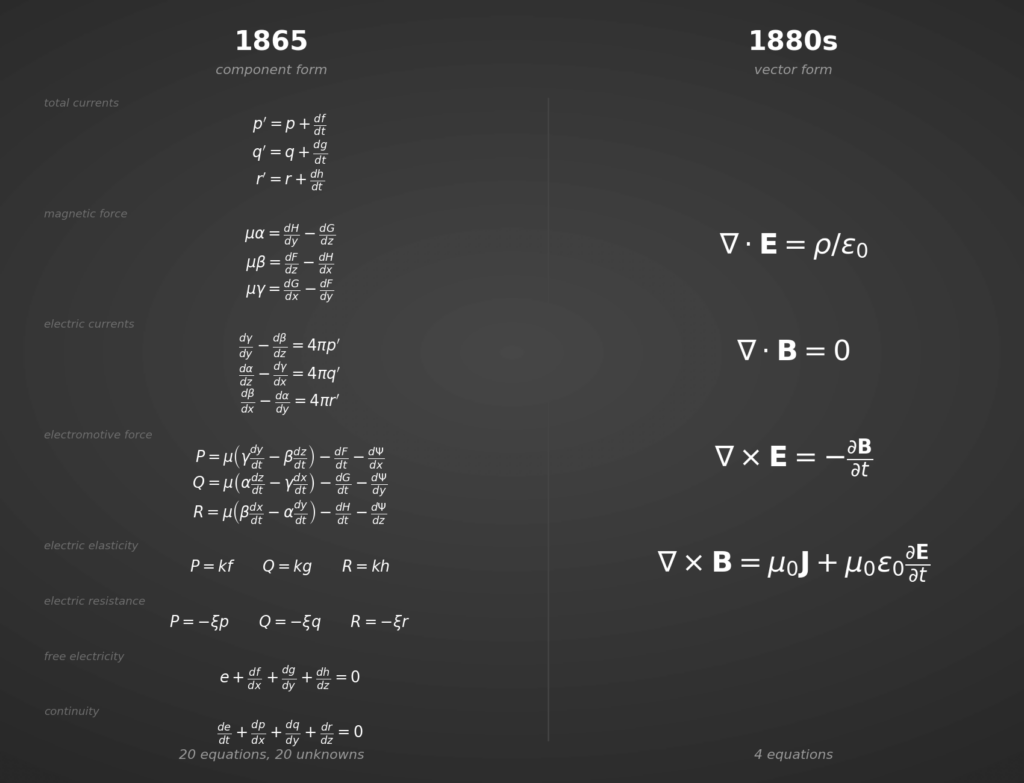
What there is instead is twenty equations in twenty unknowns, written out component by component in Cartesian coordinates. Faraday’s law occupies three separate lines, one each for the components Maxwell calls P, Q and R. The Ampère–Maxwell law occupies three more, for α, β and γ. Derivatives appear one axis at a time: d/dx, then d/dy, then d/dz. There is no Hamiltonian product anywhere, no scalar-plus-vector object, nothing that requires the algebra carved on Broom Bridge.
The count itself is the giveaway. Twenty equations are needed precisely because each vector relation has to be written three times over. With a compact formalism — any compact formalism — four will do, which is exactly what Heaviside would later demonstrate.
This does not mean Maxwell lacked the vector idea. He plainly had it. The quantities we now write as single bold letters are there in his text as triples of separate symbols: the electric field as (P, Q, R), the magnetic induction as μ(α, β, γ), the vector potential as (F, G, H). He knew these belonged together. He had no notation in working order that would let him say so in one line.
Worth noting in passing: the twenty equations also include Ohm’s law, the force on a moving charge, and the continuity of electric charge — relations nobody today calls one of Maxwell’s equations. The set we now teach under his name was not only re-notated after his death. It was reselected.
1870, and the Treatise
Maxwell’s interest in quaternions was real, and it came later.
In November 1870 he wrote a manuscript specifically on the application of quaternions to electromagnetism, and he corresponded on the subject with Peter Guthrie Tait — Hamilton’s collaborator, and the most committed advocate the algebra had in Britain. In the Treatise on Electricity and Magnetism of 1873, a more condensed quaternion notation appears for the general field equations, in the second volume.
So the honest sequence is: no quaternions in 1865, a manuscript on the question in 1870, condensed quaternion notation in the 1873 Treatise. The mythology compresses this into a single origin that never existed.
Even in the Treatise, the use is limited. On the analysis of the historian André Waser, Maxwell employed quaternions as an expository and symbolic language rather than as an operational tool — a way of displaying the structure of a result, not a machinery he calculated in daily. Whether that judgement holds under a page-by-page reading of the relevant chapter is a question worth putting to the original text rather than taking on authority, and one I intend to return to.
The most defensible summary is this: Maxwell was genuinely interested in quaternions, adopted them partially, and never brought their systematic use in electromagnetism to completion. He introduced the tool into the subject. He did not build with it.
Heaviside, Gibbs, and the four equations
Maxwell died in 1879, at forty-eight.
The reformulation came afterwards. Through the 1880s, Oliver Heaviside — self-taught, working outside the institutions, and in financial difficulty for much of his life — developed a vector calculus and rewrote the twenty equations into the four with divergence and curl that are now universal. Josiah Willard Gibbs arrived at substantially the same system independently at Yale.
The chronology matters for the story. There was no confrontation between Maxwell and Heaviside over notation, and Maxwell did not live to see his own formulation set aside. Whatever was decided about quaternions in electromagnetism was decided by other people, in a debate he was not present for.
Why the vector form won is not mysterious. It was fitted to the problems that mattered at the moment it appeared. The rising technology of the period was radio, and radio is dominated by transverse waves in free space, where the vector calculus is exactly adequate and quaternions are overhead. Heaviside’s system was leaner for the work in front of it, and it worked — unambiguously, for well over a century, underwriting almost everything electrical that followed.
The war of the vectors
The quaternionists did not concede quietly. Through the 1890s, in the pages of Nature and elsewhere, Tait fought a long rearguard action against Gibbs and Heaviside, defending Hamilton’s algebra as the proper language of physics against what he regarded as a mutilation of it.
He lost, comprehensively. By the turn of the century the vector notation was standard in physics teaching, and quaternions had been pushed to the margins of the curriculum, where they remained until computer graphics and spacecraft attitude control found a use for them in representing rotations — a role that has nothing to do with the one Tait was arguing for.
The point worth holding onto is who was arguing. The defence of quaternions in electromagnetism was mounted by Tait, not by Maxwell, and it was mounted after Maxwell was dead.
Abandoned, not refuted
Nothing in this history involves anyone showing that the quaternion approach to electromagnetism was wrong. No calculation failed, no prediction came out false, no inconsistency was exposed. The programme was not defeated. It was set down, by a man who had other things to finish, and never picked up again — because within a few years something more convenient had arrived for the problems then at hand.
That is a weaker claim than the mythological version, and a more durable one. It also leaves a question standing that the mythological version answers too quickly. If a formalism is put aside because it is heavier than the problems of the day require, the natural thing to ask is what happens at problems it was never tested against — and whether the reduction that made the vector calculus so efficient for transverse waves in free space discarded anything along with the notation.
That question does not answer itself, and it is not answered here. But it is a real question, and it is worth keeping the history straight in order to ask it properly.
Sources
- J. C. Maxwell, “A Dynamical Theory of the Electromagnetic Field,” Phil. Trans. R. Soc., vol. 155, pp. 459–512, 1865. Read 8 December 1864.
- Manuscript, Royal Society Archives, PT/72/7 — received 27 October 1864.
- J. C. Maxwell, A Treatise on Electricity and Magnetism, vol. 2. Oxford: Clarendon Press, 1873, Ch. IX.
- A. Waser, “On the Notation of Maxwell’s Field Equations,” AW-Verlag, 2000.
- O. Heaviside, Electromagnetic Theory, 3 vols. London: The Electrician, 1893–1912.
- W. R. Hamilton, “On quaternions,” Proc. R. Irish Acad., vol. 3, pp. 1–16, 1847.
- M. Longair, “A commentary on Maxwell (1865),” Phil. Trans. R. Soc. A, vol. 373, 20140473, 2015.
Leave a Reply